ENG1 English Composition I is one of WGU's standalone single courses, listed by course code rather than paired with a separate catalog number in the catalog record, and working through expressive, narrative, interpretive and argumentative approaches to writing. The catalog notes it is a distinct code from C455 and D269 and is also listed as ENG with FWS, which matters when you go looking for materials. WGU standalone courses carry between two and four competency units.
What English Composition I is actually testing
The four approaches named in the catalog are not four topics, they are four relationships between a writer and a subject, and knowing which one a task calls for determines everything about how you write it. Expressive writing puts the writer at the centre and treats personal experience as the material. Narrative writing organizes events in time to produce meaning. Interpretive writing takes a text or an artifact and explains what it does and how. Argumentative writing takes a contestable position and defends it with evidence against alternatives.
Most returns in a composition course come from mode confusion. A task asking for interpretation that receives a summary has answered a different question. A task asking for argument that receives a balanced overview of both sides has declined to take the position the task required. Reading the prompt for the verb, and matching your approach to it, is the single most valuable habit in the course.
Thesis quality is the second thing under examination, and the test is simple: could a reasonable person disagree with your thesis. A statement that nobody would contest is a topic announcement rather than a thesis. Composition rubrics reward a thesis specific enough to constrain what belongs in the essay and contestable enough to need supporting.
The third is source handling, which is where composition courses do their most durable work. Summarizing, paraphrasing and quoting are different moves with different purposes, and integrating a source means introducing it, presenting the material, citing it and then saying what it does for your argument. A quotation dropped into a paragraph with no framing is the most common structural weakness in first-year writing.
Turning scored aspects into an essay plan
WGU keeps the scoring detail inside your Course of Study rather than the public catalog. Open the rubric before outlining. Each aspect is scored on its own against a three-point scale, a 2 in each aspect passes the task, and no aspect compensates for another. That means a beautifully written essay with a missing source integration aspect comes back, and a plainer essay that answers every aspect does not.
Where your course is assessed by a performance assessment, give each scored aspect a visible home. In a composition course the natural instinct is to write a flowing essay with no headings, and where the directions permit headings, using them makes the evaluator's job trivial and yours safer.
The word budget, worked. Assume five scored aspects and directions calling for roughly 1,500 words. Reserve 150 for an introduction that ends on the thesis, and 120 for a conclusion that does more than restate. That leaves about 1,230 across five aspects, or 245 each. Then rebalance: an aspect asking you to develop and support your position deserves 400, funded by keeping any aspect that asks for description or context near 170.
Budget revision time separately and protect it. Composition is the one subject where a first draft is genuinely not the deliverable, and an essay written and submitted in a single sitting is visible as one to anyone who reads a lot of student writing.
A structure that fits a composition deliverable
Task directions govern required components and format. Where the arrangement is yours, this order works for most academic essays.
| Section | What belongs in it | How it tends to be scored |
|---|---|---|
| Introduction | Context in two or three sentences, narrowing to the thesis | Scored for the thesis; the lead-in is scaffolding |
| Thesis | One contestable sentence stating your position | The aspect everything else is measured against |
| Body paragraphs | One idea each, with a claim, support, and analysis of the support | Scored for the analysis; evidence alone is not development |
| Source integration | Introduced, presented, cited and then interpreted | Dropped quotations are the standard weakness |
| Counterargument | Where the mode calls for it, the strongest objection and your response | Strengthens argument essays substantially and is often required |
| Conclusion | What follows from the argument, not a summary of it | Scored for adding something rather than repeating |
| References | Every cited source, formatted as the task specifies | Mismatch between in-text citations and the list is a fast return |
Give each body paragraph one idea and start it with a sentence that states that idea. Paragraphs that begin with a quotation or a fact make the reader work out what the paragraph is for, and readers who are scoring do not have to do that work.
Evidence craft in a composition course
Composition is where the academic conventions of source use are established, and they are assessed directly rather than assumed.
- Introduce every source before quoting it, with enough about its authority for a reader to weigh it.
- Follow every quotation with your own sentence explaining what it establishes. The interpretation is the scored part.
- Paraphrase in genuinely different sentence structure, not by swapping synonyms into the original shape, and cite it regardless.
- Match in-text citations to the reference list exactly. Every entry cited, every citation listed.
- Keep quotation sparing. WGU requires that submissions be scannable through a similarity check and expects sources to be attributed, and heavy quotation looks like thin work even when every quotation is cited.
- Prefer sources you can characterize. If you cannot say who produced something and why they would know, it is not doing much for your argument.
The habit that most improves student writing is reading the draft aloud. Sentences that lose their way, paragraphs that have two ideas in them and transitions that do not connect are all audible in a way they are not visible.
What separates Competent from an essay sent back
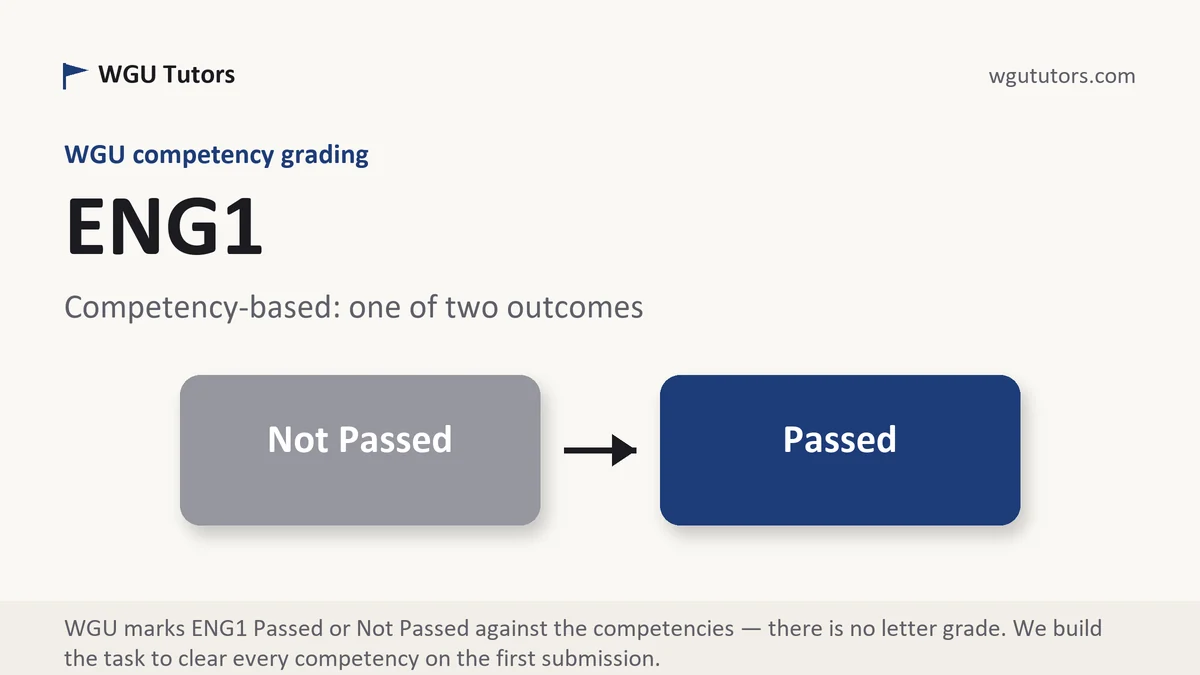
Work is Competent or Not Competent, with no letter grades and no ordinary grade point average. Performance assessment work can be revised and resubmitted without a grade penalty, so a return costs days inside a six-month flat-rate term rather than a mark.
Composition tasks that pass on the first read tend to have:
- The mode matched to the task verb: interpretation where interpretation was asked for, argument where argument was.
- A thesis a reasonable person could dispute.
- One idea per paragraph, announced in the opening sentence.
- Every source introduced, cited and interpreted rather than dropped.
- In-text citations and the reference list in exact correspondence.
- A conclusion that draws an implication rather than restating the introduction.
Where any objective assessment forms part of your plan, the boundary is absolute. Objective assessments at WGU are proctored, so support is preparation only, and we never ask for portal credentials.
Six mistakes that cost time in ENG1
- Summarizing when asked to interpret. Retelling what a text says answers a different question from explaining what it does.
- A thesis nobody would argue with. If no reasonable person could disagree, there is nothing for the essay to establish.
- Dropped quotations. A quotation with no introduction and no following interpretation leaves the development aspect unanswered.
- Paraphrase too close to the original. Changing words while keeping the sentence shape is not paraphrase, and it creates an authenticity problem as well as a writing one.
- Citation and reference list out of step. Every source cited must appear in the list and every listed source must be cited, and mismatches are checked directly.
- Submitting the first draft. Composition is the subject where revision is the work, and single-sitting essays are recognizable.
How support works on this course
Composition support is review and coaching against your rubric, not written work handed over. Send the rubric from your Course of Study and the task directions with your draft. You get the mode checked against the prompt verb, the thesis sharpened until it is contestable, paragraphs reorganized to one idea each, sources reframed so each one is introduced and interpreted, citations reconciled with the reference list, and a revision plan you carry out yourself.
The catalog notes that ENG1 is a distinct code from C455 and D269 and is also listed as ENG with FWS, so make sure any study material or sample you gather matches the competencies in your own Course of Study rather than one of the other composition courses.
Questions students ask about ENG1
Is ENG1 the same as C455 or D269?
Does ENG1 have a catalog number?
Can you write my essay for me?
Thesis nobody would argue with?
Send your rubric, the task directions and your draft. You get the mode checked against the prompt, the thesis sharpened, and every source reframed so it is introduced and interpreted.