DPS Dynamic Public Speaking is one of WGU's standalone single courses, listed by course code alone rather than paired with a separate catalog number in the catalog record, and covering how to shape a message for a specific audience, organize ideas for clarity, support points with evidence and refine delivery. WGU's standalone courses carry between two and four competency units. The deliverable is spoken, which changes preparation completely: everything that would be revision in a writing course has to happen before you press record.
What support can and cannot do for a speaking course
The line is simple and worth stating first. You deliver the speech. Nobody else records it, performs it, appears in it or speaks any part of it, and no submitted recording should contain anyone presenting your work but you. That is not a formality; the assessment is whether you can speak, and a recording of somebody else answers a different question.
What is legitimately supportable is preparation, and in a speaking course that is nearly all of the work. Audience analysis, thesis sharpening, outline structure, transitions, evidence selection, timing the script, anticipating the questions a listener would raise, and rehearsal method are all coaching on a deliverable. Speakers who prepare properly improve enormously; speakers who write a script the night before rarely do.
What Dynamic Public Speaking is actually testing
Audience analysis is the foundation and it is more concrete than it sounds. It means answering specific questions before writing a word: what does this audience already know, what do they already believe, what do they stand to gain or lose from your position, and what will make them stop listening. The same content organized for a sceptical audience and a sympathetic one is genuinely different content, and a speech that ignores the difference is a speech written for the speaker.
Organization is tested because listeners cannot re-read. A reader who loses the thread can go back a paragraph; a listener cannot. That is why spoken structure is more repetitive than written structure and should be: preview what is coming, signal each transition audibly, and summarize before moving on. Those moves feel heavy-handed on the page and are exactly what makes a speech followable in the room.
Evidence in speech has to be both credible and sayable. A statistic that takes fifteen seconds to state loses the audience before it lands. Naming the source briefly, giving the figure in round terms and saying immediately what it means is the spoken equivalent of a citation, and it is a scored skill in its own right.
Delivery is assessed as a set of controllable behaviours rather than as charisma. Pace, pauses, eye contact with the camera or audience, gesture that supports rather than distracts, and the elimination of filler sounds are all things that improve measurably with rehearsal. Nobody is being scored on natural talent.
Turning the rubric into a speech plan
WGU keeps scoring detail inside your Course of Study rather than the public catalog. Read the aspects before writing anything, because a speech has a fixed running time and every unassessed minute is taken from an assessed one. Each aspect is scored on its own against a three-point scale, and a 2 in each aspect passes the task.
Where your course is assessed by a performance assessment, treat the aspect list as a running order and make your transitions audible enough that an evaluator listening with the rubric can hear when you move from one to the next.
The word budget, worked. Speech budgets convert from time. A comfortable delivery pace is roughly 130 words a minute, so a seven-minute speech is about 910 words and a ten-minute speech about 1,300. Take an eight-minute speech at 1,040 words: reserve 120 for an opening that earns attention and states the thesis, and 100 for a close that lands the point. That leaves about 820 for the body. Across three main points that is 270 words each, which is barely two minutes apiece.
Knowing that number early prevents the standard failure, which is a script with five main points that cannot possibly fit and gets truncated live. Three points delivered fully always beats five points delivered partly.
A structure that fits a spoken deliverable
Your task directions govern required content and any time limit. Where the arrangement is yours, this order is built for listeners rather than readers.
| Segment | What belongs in it | How it tends to be scored |
|---|---|---|
| Attention opening | A question, a specific example or a concrete image, in under thirty seconds | Scored for relevance; an unconnected opening reads as a device |
| Thesis and preview | One sentence stating your position, then the three points to come | The preview is what lets a listener follow the whole speech |
| Main points | Each with a claim, evidence, and a statement of what it means | Scored for support; assertions without evidence are the standard return |
| Transitions | Audible signals between points, spoken rather than implied | Cheap to write and a frequent source of clarity marks |
| Audience adaptation | Language, examples and framing chosen for this audience | Where analysis becomes visible in the speech itself |
| Conclusion | Summary, restated thesis and a closing line worth remembering | Scored for landing rather than trailing off |
| Sources | Oral citations in the speech and a written reference list where required | Both are usually expected; check your task directions |
Rehearse against a timer from the first run, not the last. A speech discovered to be two minutes long on the day of recording gets cut in whatever section happens to be last, which is usually the conclusion where the scoring weight sits.
Evidence craft when the audience cannot re-read
Spoken evidence follows different rules from written evidence, and the differences are practical rather than stylistic.
- Cite orally in a short phrase: the source, its authority in three words, and the year. Long citations stall the sentence and lose the room.
- Round your numbers. Nearly two thirds is remembered; sixty-four point seven percent is not.
- Say what the evidence means immediately after giving it. Listeners do not have time to work out the implication themselves.
- Prefer one developed example to three brief ones. Depth is memorable and breadth is noise in a spoken format.
- Keep a written reference list where the task requires it, formatted in APA, even though it is never spoken.
- Attribute anything you did not write, and keep any read passages minimal, since WGU scans submitted materials through a similarity check.
The habit that improves speeches most is reading the script aloud early. Sentences that work on the page routinely fail in the mouth, and a construction you stumble over in rehearsal is one you will stumble over on the recording.
What separates Competent from a speech sent back
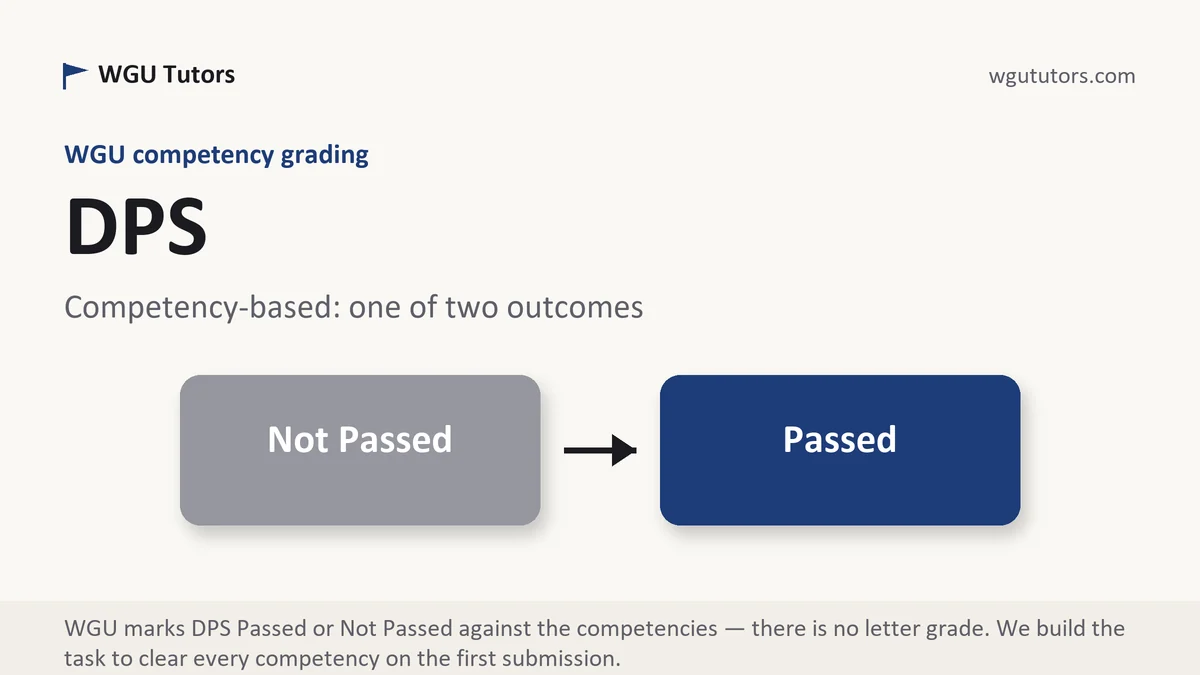
Work at WGU is Competent or Not Competent. There are no letter grades and no ordinary grade point average, and performance assessment work can be revised and resubmitted without a grade penalty. For a recorded speech that means re-recording, which costs more real time than editing a document does, so preparation is worth more here than in almost any other course.
Speeches that pass on the first submission tend to have:
- A thesis stated in one sentence within the first minute.
- A preview of the main points, so a listener knows the shape.
- Every main point supported with evidence that is orally cited.
- Audible transitions between sections.
- Delivery within the stated time limit, verified in rehearsal.
- A conclusion that summarizes and lands rather than fading out.
Six mistakes that cost time in DPS
- Writing an essay and reading it. Written syntax is too dense to follow by ear, and a read essay is audible as one within a sentence.
- Too many main points. Five points in an eight-minute speech guarantees that something gets cut live.
- Silent transitions. A listener cannot see your paragraph breaks, so the move between points has to be spoken.
- Evidence without interpretation. A statistic delivered and left alone does nothing, because the audience has no time to process it.
- No oral citation. Where a task requires sources, they generally have to be credited aloud as well as listed in writing.
- Rehearsing silently. Reading in your head is not rehearsal, and it hides every sentence that does not work spoken.
How support works on this course
To restate the boundary: you deliver the speech, and no part of the recorded performance is something anyone else should touch. Support is preparation. Send the rubric from your Course of Study and the task directions. The work comes back as an aspect-mapped speech plan with a timed script, a thesis sharpened to one sentence, main points cut to what will actually fit, transitions written to be spoken, oral citations shortened so they do not stall the sentence, and a rehearsal schedule that catches the sentences that fail out loud.
Because this is a standalone course rather than a program-embedded one, check your own Course of Study for the competency unit value and requirements attached to your enrolment, since WGU standalone courses carry between two and four units.
Questions students ask about DPS
Does DPS have a separate catalog number?
Can someone record the speech for me?
How long should each main point be?
Speech running long and losing the ending?
Send your Course of Study rubric and the task directions. You get a timed, aspect-mapped plan with the thesis sharpened, points cut to fit and transitions written to be spoken.