Bachelor of Science, Nursing - Prelicensure (Pre-Nursing) course guide
The complete July 2026 standard path for Bachelor of Science, Nursing - Prelicensure (Pre-Nursing): every catalog row, WGU course code, CCN where published, competency-unit value, and term position wired to the course layer.
19 of 19 nonzero course rows link to live course guides. The path runs through 4 catalog terms; those term numbers describe WGU's standard sequence, not a fixed weekly calendar.
Program shape and the catalog boundary
WGU lists 61 competency units for this bachelors program. The grid begins with D265, D269, C165, D268 and closes with D202, D236, D441, D439. It is a public standard path, not an individual transfer evaluation: accepted credit, licensure, prior learning, substitutions, program revisions, state requirements, and mentor planning can change a student's actual Degree Plan.
Nursing plans combine competency-based academic work with professional and, in some pathways, clinical or field requirements. The student performs every hour, interaction, assessment, and professional decision; support is limited to preparation and the written reasoning layer.
The catalog establishes membership and sequence, but it does not publish each course's assessment type or Task 1/Task 2 identities. Open the current Course of Study before planning deliverables. A course page on this site explains the reasoning method and program connections; a separate assessment manual appears only where WGU has publicly verified the real task.
The classes, one by one
| Term | WGU code | CCN | Catalog title | Coverage |
|---|---|---|---|---|
| 1 | D265 | PHIL 1020 | Critical Thinking: Reason and Evidence | Course guide linked |
| 1 | D269 | ENGL 1711 | Composition: Writing with a Strategy | Course guide linked |
| 1 | C165 | SCIE 1020 | Integrated Physical Sciences | Course guide linked |
| 1 | D268 | COMM 3015 | Introduction to Communication: Connecting with Others | Course guide linked |
| 1 | D198 | HUMN 1020 | Global Arts and Humanities | Course guide linked |
| 2 | D425 | SCIE 2030 | Introduction to Chemistry | Course guide linked |
| 2 | D312 | SCIE 1011 | Anatomy and Physiology I with Lab | Course guide linked |
| 2 | C180 | PSYC 1010 | Introduction to Psychology | Course guide linked |
| 2 | D266 | HIST 1016 | World History: Diverse Cultures and Global Connections | Course guide linked |
| 2 | C784 | MATH 1100 | Applied Healthcare Statistics | Course guide linked |
| 3 | D313 | SCIE 1012 | Anatomy and Physiology II with Lab | Course guide linked |
| 3 | D311 | NURS 1010 | Microbiology with Lab: A Fundamental Approach | Course guide linked |
| 3 | C273 | SOCG 1010 | Introduction to Sociology | Course guide linked |
| 3 | D440 | NURS 2001 | Health and Wellness Through Nutritional Science | Course guide linked |
| 4 | C957 | MATH 1200 | Applied Algebra | Course guide linked |
| 4 | D202 | PSYC 1020 | Human Growth and Development | Course guide linked |
| 4 | D236 | NURS 2508 | Pathophysiology | Course guide linked |
| 4 | D441 | NURS 2002 | Medical Dosage Calculations and Pharmacology | Course guide linked |
| 4 | D439 | NURS 1011 | Foundations of Nursing | Course guide linked |
How to read a WGU standard path
A term number is a recommended position inside a six-month enrollment term, not a promise that a course begins on a universal date or lasts a universal number of weeks. Students usually work through courses in sequence, but acceleration, transfer credit, course availability, field requirements, and mentor decisions can change the order. The live Degree Plan is the student's blueprint.
Use the grid in three passes. First, mark courses already satisfied or transferred. Second, identify courses with external constraints—clinical placement, field experience, simulation, certification, employer project, or a capstone dependency. Third, classify the live assessment instrument from the Course of Study so PA drafting and OA preparation can run on different tracks.
Do not convert the table into a calendar by dividing CUs across weeks. Competency units express academic value, not report length, task count, or exam date. A small-CU course can carry a complex applied artifact, and a larger course can be assessment-heavy in a completely different way.
Run the program as one connected system
Maintain a program ledger with the course code, current instrument, dependencies, target date, evidence needed, and next action. For written work, add the approved problem, audience or population, key definitions, data choices, and evaluator feedback. For exam work, add the preassessment result by competency, practice dates, and go-or-wait decision.
The ledger prevents local success from creating downstream rework. A market definition, patient population, accounting assumption, policy interpretation, or data source introduced early should not silently change in a later capstone. When a course genuinely requires a new premise, record the reason and update every dependent artifact.
Flat-term tuition makes idle time expensive, but acceleration has to stay evidence-led. Keep one PA and one OA-prep lane moving where the Degree Plan permits, front-load externally constrained work, submit only after every rubric aspect is visible, and schedule a proctored exam only after practice shows stable readiness.
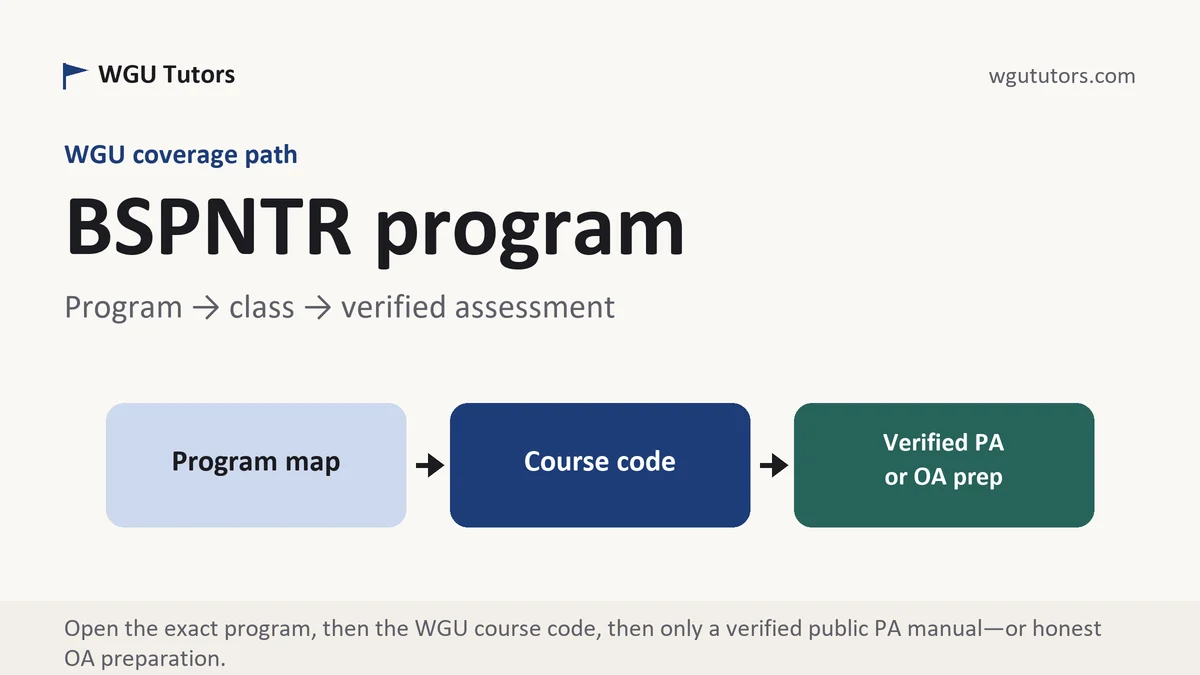
Program → class → verified assessment
This page is the program layer. Each linked code opens the class layer with course-specific writing, evidence, data, and competency guidance. The final layer is a public assessment manual, but WGU keeps most task identities inside the authenticated Course of Study. Publishing a generic Task 1 would create the same phantom-assignment problem the network's verification rules were designed to stop.
The WGU rule is therefore strict: at most one PA manual per course, and only when a current WGU-controlled public source verifies its identity and requirements. Objective assessments remain preparation-only. Students sit every proctored exam personally, and tutors never request or use portal credentials.
Quality gates before a course is marked complete
Use three different completion tests because a WGU course can ask for fundamentally different proof. A written PA is ready when every current rubric aspect has an evaluator-visible answer, the evidence supports the nearby claim, the required template and file type are correct, and a final read can trace the conclusion back to facts or analysis. An OA is ready when practice evidence is stable across the tested competencies, not merely when one familiar question set has been memorized. Applied work is ready only after the real activity, approval, hours, documentation, and professional obligations are complete.
Record returned work as structured evidence rather than as a general setback. Put each evaluator comment beside the affected rubric aspect, diagnose whether the gap is coverage, explanation, evidence, calculation, format, or source use, and revise the smallest complete unit that resolves it. Then run a regression pass across dependent sections and files. A changed assumption in a spreadsheet, for example, may alter a recommendation, chart, executive summary, and capstone narrative even if the evaluator named only one location.
At the program level, “done” therefore means more than a checked course tile. Keep a compact completion record: official code and title, live assessment instrument, version or date of directions, submission outcome, retained feedback, and any definition, dataset, population, policy, or assumption that later courses may reuse. This creates continuity without treating an old task as the specification for a new one. The current Course of Study always wins when a course changes.
Close each term by reconciling that record with the Degree Plan and the next registered course.
Applied and professional responsibility
The student remains responsible for the real case facts, calculations, research choices, team participation, professional decisions, originality, and final submission. Tutoring supports learning, planning, and revision without impersonating the student.
De-identify patient, employee, customer, and organizational information before sharing any artifact. A tutor can help trace claims to evidence, test whether a measure fits the question, reconcile numbers, improve structure, and prepare for an exam. A tutor cannot create events that did not happen or complete an authenticated assessment.