E012 Information Technology Management and Leadership carries the banner number ITIM 5531 and is worth 3 competency units. The course covers the technical and the human elements of managing technology together: identifying the components that make up an organization's technology infrastructure, and understanding how those components relate to one another. E012 and ITIM 5531 name one requirement, not two. It is the graduate course that asks you to stop describing systems as a technician and start accounting for them as the person responsible for them.
Infrastructure is a set of dependencies, not a list of boxes
Most students arrive at E012 able to name every layer of a technology stack. The course wants something harder. It wants the relationships: which component fails when another one does, which service silently depends on a piece of infrastructure nobody has documented, and which of those dependencies would be visible to a customer within ten minutes of an outage. A submission that inventories servers, networks, applications and endpoints without ever connecting them is answering an easier question than the one asked.
The leadership half is not decoration attached to the technical half. Managing technology means managing the people who run it, the vendors who supply it and the executives who fund it, and each of those relationships fails in a characteristic way. Technical staff leave when their work is invisible. Vendors expand scope when nobody owns the contract. Executives defund what they cannot explain. The course keeps asking you to say what a manager would actually do, and the answer is almost never a technical answer alone.
Graduate level here means a specific thing: you are expected to take a position and defend it, not to survey the options. If a scenario presents a choice between consolidating two systems and leaving them separate, the work is to choose, name what you gave up by choosing, and say what evidence would change your mind. Writing that lists advantages and disadvantages and then declines to decide reads as incomplete to an evaluator, because a manager who cannot decide is not doing the job the course is about.
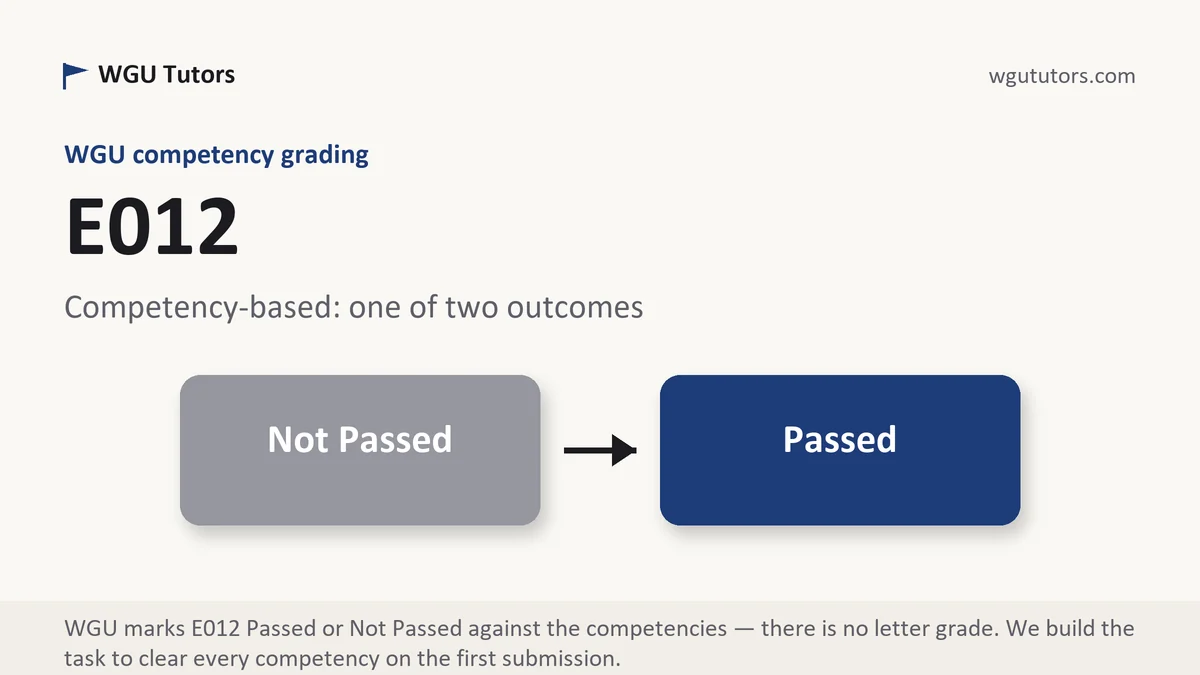
WGU records outcomes as Competent or Not Competent, without letter grades and without an ordinary grade point average, and the 3 competency units size this course inside a flat rate six month term. Closing it early does not just clear a requirement; it frees term capacity you have already paid for.
Turning scored aspects into a management memo plan
If your version of E012 is assessed by a performance assessment, the aspects your evaluator scores are the outline. Not the prompt, not the reading, and not the order in which you happened to think of things. WGU requires a score of 2 in every aspect for a task to pass, and each aspect is judged on its own, so a superb infrastructure analysis does not rescue an unanswered leadership aspect.
Build the budget before you write a sentence. Take a rubric carrying five scored aspects and a target near 1,900 words. Reserve 130 words to establish the organization and its technology footprint, and 90 for the close, which leaves 1,680 words to distribute. Weight by what each aspect demands rather than splitting evenly: two aspects that require you to analyze relationships between components and justify a management decision take 420 words each, because each needs the evidence, the reasoning and the decision. The three remaining aspects, which typically describe, classify or recommend, take 280 each. Two at 420 is 840, three at 280 is 840, and the total lands on 1,680 exactly.
Give every aspect its own heading, worded in the language of the aspect. Evaluators are reading against a checklist, and a heading that echoes the aspect converts a search into a confirmation. It also protects you from your own drafting, because an aspect with a heading and no paragraph under it is impossible to miss at the final read.
Leave one slot in the budget for the thing students always cut first: the consequence. Naming a dependency is half an answer. Saying what happens to the business when that dependency breaks is the other half, and it is the half that reads as graduate work.
Shape for an infrastructure and leadership analysis
E012 deliverables usually take the form of a management memo or report about a described organization. These proportions carry that document without leaving a section starved.
| Section | What belongs there | Share |
|---|---|---|
| Organizational context | What the business does, its size, and what technology has to deliver for it to operate at all. | 10 percent |
| Infrastructure components | The layers actually in play here, named specifically rather than generically. | 16 percent |
| Dependency analysis | How the components relate, which ones are single points of failure, and what breaks downstream. | 22 percent |
| Management implications | What those relationships mean for staffing, vendor contracts, budgets and escalation. | 18 percent |
| Leadership response | The decision you take, the leadership approach behind it, and how it is communicated to each audience. | 16 percent |
| Measures | How anyone would know the response worked, expressed as something observable. | 12 percent |
| Close | Residual risk and the evidence that would change your recommendation. | 6 percent |
Evidence for management claims
The claim types in this course divide cleanly, and each one needs a different kind of support. Claims about how a technology behaves are supported by vendor documentation, standards bodies and technical references. Claims about how organizations behave are supported by management and information systems literature. Claims about this organization are supported by the scenario, and only by the scenario.
Mixing those categories is the sourcing error that shows up most often. A student cites a well known management study to support a statement about how a particular database replicates, or cites a product datasheet to support a claim about how technical teams respond to change. Both citations are real and neither one supports the sentence attached to it.
Prefer peer reviewed sources for the leadership half. Practitioner blogs are useful for orientation and weak as evidence, and a graduate evaluator can tell the difference in a line. The WGU library gives you database access without cost, and twenty minutes there is worth more than an hour of open web searching for a course at this level.
Where you make a quantitative claim, tie it to something. Saying that consolidation reduces administrative overhead is an assertion. Saying it removes one of two patching cycles, one of two vendor relationships and one of two license renewals is a claim an evaluator can check against your own analysis. Use the citation style your task specifies, cite at the point of the claim rather than gathering everything at the end of a paragraph, and make sure every entry in the reference list is actually cited in the text.
What earns Competent, and what comes back
Work that passes here reads like it was written by someone accountable for the outcome. It names specific components rather than categories, traces at least one dependency chain all the way to a business consequence, takes a management position and supports it, and says how success would be observed. It also answers every aspect in terms the aspect would recognize.
Returns cluster into a few recognizable shapes. The paper describes infrastructure accurately and never analyzes it. The leadership section becomes a summary of leadership styles with no application to the scenario. The recommendation is generic enough to apply to any organization on earth. Or one aspect is answered inside a paragraph belonging to another aspect, where the evaluator never finds it.
A useful final check: read only your own topic sentences, in order. If that sequence tells a coherent story from context to decision, the document is structured. If it reads as a list of topics, the sections are sitting next to each other rather than building on one another, and that is what a returned submission usually feels like from the evaluator's side.
Because performance assessment work at WGU can be revised and resubmitted without a grade penalty, the target at submission is not a perfect document, it is a genuine answer in every aspect. If your version of the course also carries an objective assessment, that exam is proctored, and our boundary is absolute: we prepare you beforehand with concept drills, terminology work and a candid read on your preassessment. We do not sit an assessment, we take no part while one is under way, and we never request or hold portal credentials.
Describing the infrastructure instead of managing it?
Send the E012 rubric and your scenario. We rebuild it aspect by aspect with word targets and a dependency chain that ends in a business consequence.
Six mistakes that cost time in E012
- Inventorying instead of relating. The course is about how components depend on each other. A clean list with no connections answers a smaller question.
- Leaving leadership as a separate essay. The technical analysis should produce the management problem, and the management problem should produce the leadership response.
- Refusing to decide. Weighing options and stopping there reads as unfinished at graduate level. Choose, and say what you traded away.
- Generic recommendations. If the recommendation would fit any company, it does not fit this one. Anchor it to a detail from the scenario.
- Citing the wrong category of source. Technology behavior comes from technical sources, organizational behavior from management literature, and facts about the scenario from the scenario.
- No measures. A recommendation without an observable indicator gives the evaluator nothing to score on effectiveness.
Three questions students ask about E012
Do I need management experience to pass E012?
How technical should the infrastructure section be?
Is E012 the same course as ITIM 5531?
Where E012 sits in WGU's programs
The July 2026 catalog places this code in 3 current WGU programs. Open a program page for the complete standard path and term positions. The live Degree Plan remains authoritative after transfer credit, substitutions, and mentor planning.
The assessments, one by one
The public catalog does not publish this course's PA/OA identity or task count. WGU Tutors publishes at most one PA manual per course and only from a WGU-controlled public rubric. Until that source exists, PA help begins from the student's real Course of Study and OA support remains preparation only.