D774 Introduction to Business Accounting, catalog number ACCT 2350, is the three-CU course that builds fundamental accounting knowledge in a business context. It is the current lower-division accounting survey at WGU and it supersedes D196 Principles of Financial and Managerial Accounting in most 2025-26 degree plans, so the two cover the same ground for the same purpose. If your Degree Plan lists D774, that is your version. If it lists D196, take that one and read this page only as a comparison.
What a business accounting survey is for
D774 is not aimed at future accountants. It is aimed at the marketing manager who will have to defend a budget, the operations lead who will be asked why the variance is negative, and the small business owner who signs the loan documents. The course therefore spends its time on accounting as a language for business decisions rather than on the mechanics of maintaining a ledger.
Practically, that means three competencies keep showing up. Reading a financial statement well enough to say what a business did last year. Distinguishing the costs that change with volume from the costs that do not, because almost every operating decision turns on that split. And using accounting information forward rather than backward, which is what a budget is.
The subject matter is genuinely approachable, and that is exactly what catches people out. Students skim, take the assessment on confidence, and discover that the questions ask for application rather than recall. Knowing that fixed costs do not vary with volume is recall. Working out what happens to the break-even point when a supplier raises unit cost by eleven percent is application, and it is what gets assessed.
Aspects into a plan, for a survey course
Whatever instrument your version of the course uses, the rubric or the competency list in your Course of Study is the map. Each scored aspect is judged on its own and needs a 2 to pass, so nothing is gained by writing beautifully about the two aspects you enjoy while leaving the third thin.
The budgeting arithmetic, worked. Suppose your rubric shows four scored aspects and the directions ask for a business briefing of about 1,600 words. Take 130 off the top for the framing paragraph and 120 for the closing, and 1,350 remains. Four aspects into 1,350 is roughly 340 each. Now apply the survey-course adjustment: in an introductory business accounting task, the aspect that asks you to interpret a figure for a non-accounting audience is worth spending on, because plain-language explanation is the whole competency. Give that one 450 and let the three others take 300 apiece. The total holds at 1,350.
Then perform a rubric check before submitting. Read each aspect's own wording, find the paragraph that answers it, and if you cannot point at that paragraph within five seconds, neither can an evaluator working through a queue. Rename the heading until you can.
Laying out a business accounting briefing
Introductory business accounting deliverables usually take the form of a briefing for a manager rather than an academic paper. This layout matches how the competencies are usually scored, and yields to your task directions wherever they differ.
| Part | What goes here | Plain-language test |
|---|---|---|
| Purpose | Who the briefing is for and what decision it supports | Could a busy owner tell from paragraph one why they should read on? |
| The numbers as given | The supplied figures restated in a small labelled table | Can a reader check your inputs without opening another file? |
| What the figures mean | Interpretation in ordinary words, no jargon left undefined | Would this sentence survive being read aloud to someone with no accounting background? |
| Cost behavior | Which costs are fixed, which are variable, and the consequence for the decision | Have you actually split the costs rather than naming the categories? |
| Forward view | The budget, the break-even, or the projection the task calls for | Is every projected number traceable to an input above? |
| Recommendation | What you would do and the single number that would change your mind | Is it specific enough to be refused? |
Small-business framing helps more than students expect. Writing as though a real owner will act on the briefing tends to eliminate the padding that survey courses attract, because nobody pads a document that somebody has to use on Monday.
Evidence habits worth forming early
This is a first accounting course for many students, which makes it the right place to build habits the rest of the degree will reward.
- Attribute every number. If it came from the case data, say which exhibit. If you computed it, show the formula once.
- Define a term the first time you use it, in one clause, then use it consistently. Contribution margin defined once is professional; defined three different ways is a returned aspect.
- Cite the course material in APA when you state a definition or a rule, and rewrite it in your own words rather than quoting, since submissions are checked for similarity.
- Distinguish fact from projection with tense and labelling. Last year's revenue is a fact; next year's is an estimate carrying an assumption you must name.
- Prefer one clear table to three paragraphs of numbers in prose. Numbers embedded in sentences are hard to check and easy to get wrong.
One more habit that pays across the whole business degree: keep a running assumptions list at the end of your document. It takes two minutes, it demonstrates the professional judgment evaluators look for, and it protects you when a reviewer disagrees with an input rather than with your reasoning.
What Competent looks like in an introductory course
The bar in a survey course is not sophistication. It is completeness and clarity, judged aspect by aspect against the standard WGU sets for competence.
- Every scored aspect has its own visible section, and no aspect is answered only inside a table.
- Every technical term used is defined once and used the same way throughout.
- Interpretation appears next to computation rather than in a separate block at the end.
- The audience stays non-specialist. Writing up to an imagined accounting professor is the classic misread of this course.
- The recommendation follows from the numbers shown rather than from general business sense.
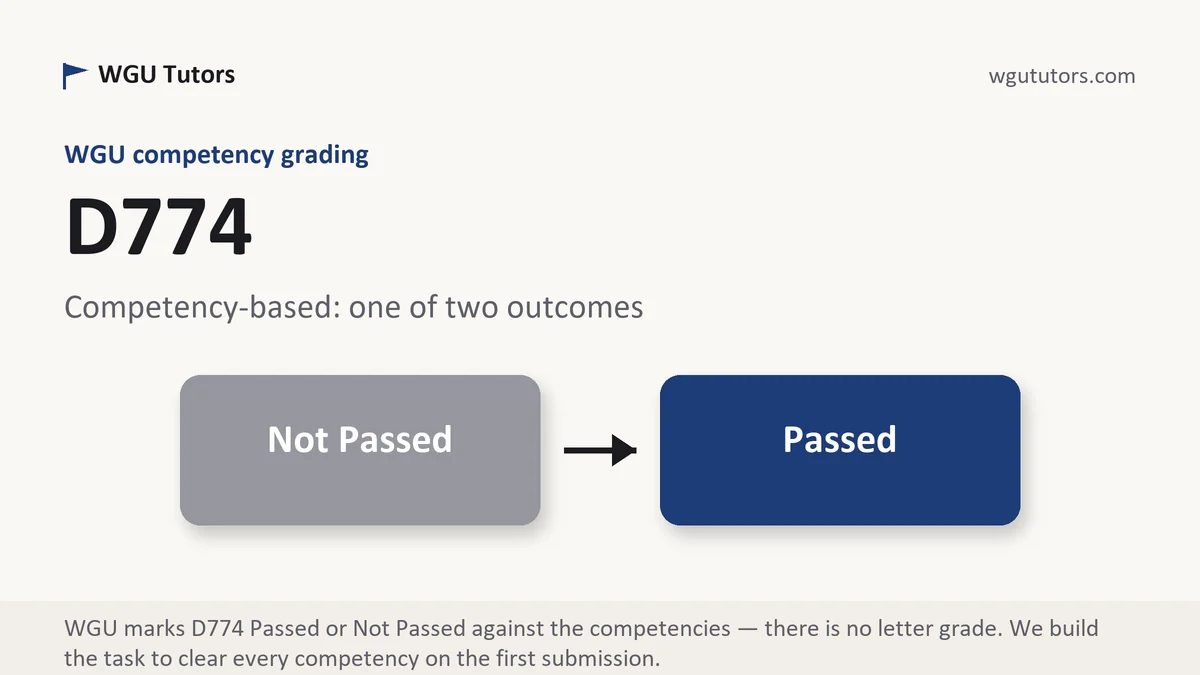
WGU records the outcome as Competent or Not Competent and calculates no ordinary grade point average, so a first attempt that comes back is a delay rather than a mark on a record. Performance assessment work can be revised and resubmitted with no penalty. The reason to get it right the first time is the calendar: your term is six months at a flat rate, and every course you close early makes the next one cheaper in effective terms.
Where your version of D774 is assessed by a proctored objective assessment, our role is preparation only. We build the study plan from the competency list, drill cost behavior and break-even problems until they are quick, and give you a straight readiness answer. We never sit an assessment and never handle portal credentials.
Five mistakes that cost time in D774
- Assuming the course is beneath you because the topics are familiar. Familiar topics assessed by application still return submissions that only recall.
- Writing for an accountant. The audience is a business decision maker, and jargon left undefined reads as not understood rather than as expert.
- Blurring fixed and variable costs. Nearly every calculation in the course depends on the split, and a mixed cost left unsplit corrupts everything downstream.
- Building a break-even without checking units. Mixing per-unit and total figures inside one formula is the most common arithmetic failure here.
- Ignoring the older course code. If your plan actually lists D196, the material overlaps but the assessment is its own, so work from the Course of Study your plan points at.
Support on this course, and which code you actually need
Before anything else, check your Degree Plan. D774 and D196 cover the same lower-division accounting ground, and newer 2025-26 plans mostly carry D774 while older ones carry D196. Working from the wrong course's material is the single biggest time sink students create for themselves here, and it is entirely avoidable in thirty seconds.
Once the code is confirmed, send the rubric and directions from your Course of Study. What comes back is a briefing drafted aspect by aspect with the cost analysis shown, the projection traceable and the language pitched at the audience the course actually assesses, plus a walkthrough so the reasoning is yours. From here the natural next steps in a business plan are D775 Introduction to Business Finance and, for accounting majors, D102 Financial Accounting.
Questions students ask about D774
Is D774 the same course as D196?
What does ACCT 2350 mean on my transcript?
Do I need this before the finance survey?
Starting the accounting survey this term?
Send your Degree Plan row so we can confirm which code you are on, then the rubric. First premium sample is free.
Where D774 sits in WGU's programs
The July 2026 catalog places this code in 8 current WGU programs. Open a program page for the complete standard path and term positions. The live Degree Plan remains authoritative after transfer credit, substitutions, and mentor planning.
The assessments, one by one
The public catalog does not publish this course's PA/OA identity or task count. WGU Tutors publishes at most one PA manual per course and only from a WGU-controlled public rubric. Until that source exists, PA help begins from the student's real Course of Study and OA support remains preparation only.