D354 carries the banner number HRM 3520 and is worth 3 competency units. The WGU catalog describes Talent Acquisition as planning, recruiting, selecting and onboarding employees, and identifying the skill gaps that make all of that necessary. It is the current replacement for the legacy course C234 Workforce Planning: Recruitment and Selection, which covers the same material under an older code. If both appear in your search results, the one on your Degree Plan is the one whose requirements matter.
The pipeline is the syllabus
D354 traces a candidate from the moment a skill gap is noticed to the moment a new hire is productive. Four stages, each with its own deliverable in professional practice: gap identification produces a role definition, recruiting produces a candidate pool, selection produces a decision that can be defended, and onboarding produces someone who stays.
Notice what the current title added compared with the legacy course. Onboarding is now inside the frame. That extension matters for assessments, because a submission that stops at the offer letter has ignored the stage the course title newly emphasises, and the aspect covering it will be scored as unaddressed. If you are working from study help written for the older code, this is the gap you inherit.
The other structural point is that talent acquisition is a funnel, and funnels have arithmetic. Applications produce screens, screens produce interviews, interviews produce offers, offers produce acceptances. Every stage has a yield. Writing about the funnel without yields is like writing about a budget without amounts, and it is the fastest way to make a strong paper read as generic.
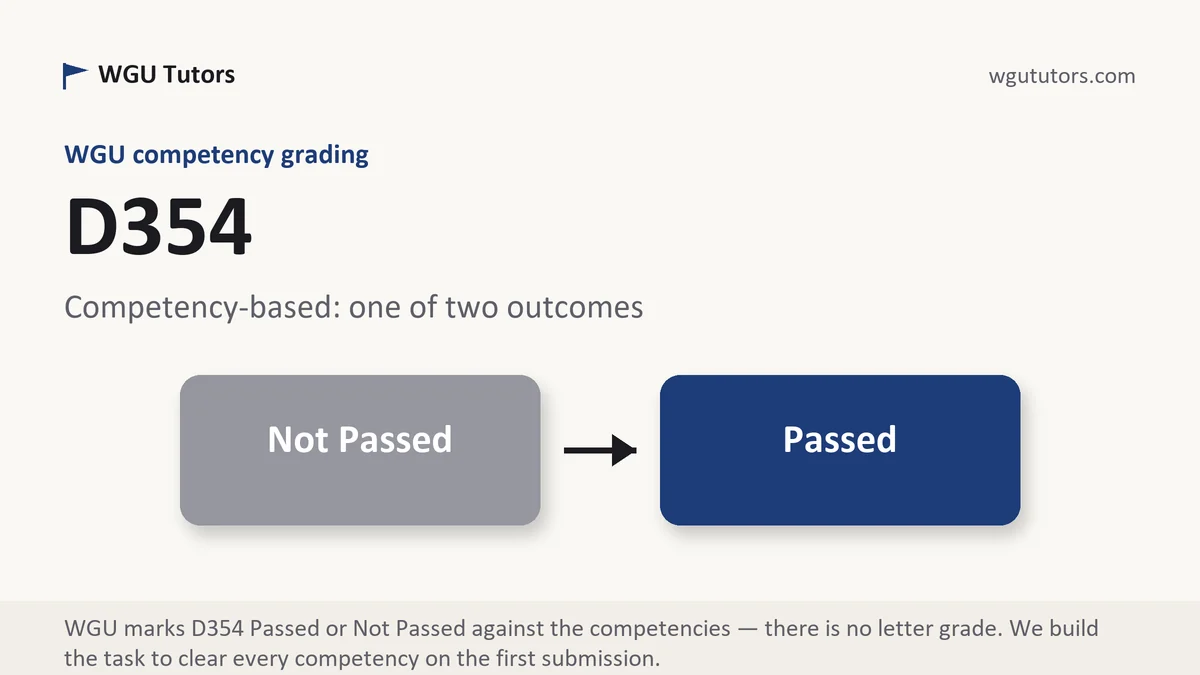
Results here are recorded as Competent or Not Competent. WGU issues no letter grades and calculates no ordinary grade point average, and performance assessment work can be revised and resubmitted without a penalty attached to the result. That makes an early complete attempt the rational move, because the feedback on a returned task is more useful than another week of private polishing.
Turning scored aspects into a pipeline document
If your course is assessed by a performance assessment, the aspects your evaluator scores are the skeleton of the document. Each is judged on its own and needs a score of 2, so put a visible heading over each one rather than trusting a reader to find it inside a longer section.
Work the numbers before you write. Suppose the rubric shows eleven scored aspects, which is common in a course covering four stages, and the deliverable is capped at roughly 3,000 words. Set aside 250 for the organizational scenario and 150 for a closing recommendation, leaving 2,600 across eleven aspects, or about 236 words each.
Then reallocate by stage rather than evenly. If five of the eleven aspects sit in selection, selection is getting 1,180 words and the other three stages share the rest, which is exactly right for a rubric weighted that way and exactly wrong for the instinct that says give every stage a quarter. Counting aspects per stage takes two minutes and is the single most reliable way to make a long deliverable land in proportion.
A final pass worth building into your process: read every aspect label and underline its verbs. Describe, justify, evaluate and recommend are four different jobs, and an aspect that says describe and justify needs two paragraphs, not one longer one.
A structure for a talent acquisition deliverable
The usual deliverable is a plan or proposal presented to a hiring leader. The stage sequence below keeps the funnel visible, which is what makes the document readable.
| Stage | Question it answers | Artefact it should contain | Yield or measure to state |
|---|---|---|---|
| Skill gap analysis | What capability is missing and why now | Comparison of required skills against current skills | Number of positions and the date the gap bites |
| Role definition | What this person will actually do | Duties and genuinely required qualifications | Level and pay band the role sits in |
| Employer positioning | Why a good candidate would choose this employer | A value proposition in the candidate's language | Offer acceptance rate as the test of it |
| Sourcing | Where the pool comes from | Named channels with a rationale each | Applications per channel, cost per application |
| Screening and selection | How the choice gets made and defended | Ordered stages, each measuring a named requirement | Pass through rate at each stage |
| Offer and negotiation | What is offered and what is flexible | Offer components and approval path | Time from final interview to signature |
| Onboarding | How the hire becomes productive and stays | A first ninety day schedule with owners | Ninety day and one year retention |
Evidence and citation craft for acquisition writing
This subject attracts more marketing content than almost any other HR topic, and separating research from vendor material is part of the skill being assessed. Prefer four kinds of source.
Government labour statistics for occupation level pay, employment and projected demand. Standardised occupational information databases for the task and skill statements behind a role definition, which stops a job analysis from being a rewrite of one company's old posting. Peer reviewed selection research for the comparative predictive validity of structured interviews, work samples, cognitive tests and reference checks, which is the evidence that makes a selection design defensible. And professional bodies for accepted process standards, including record keeping expectations.
Handle vendor benchmarks carefully. An applicant tracking vendor publishing a report on time to fill has an interest in the number. If you use it, name it as industry reporting rather than research, and pair it with something independent. In text citations belong on the sentence carrying the claim, and the reference list should be checked against the body after the last edit rather than before it.
What separates a Competent plan from a returned one
The plans that pass are the ones where each stage obviously feeds the next. The skill gap names capabilities, the role definition uses those capabilities, the selection stages measure those capabilities, and the onboarding plan develops whatever the new hire is not expected to arrive with. A reader can follow one thread from the first page to the last.
Returned plans break that thread. A selection process appears that tests nothing the role definition mentioned. Sourcing channels are listed with no reason attached. Onboarding is a welcome lunch and a laptop. Or the skill gap section is asserted rather than analysed, which undermines every recommendation that follows and can cost several aspects at once.
The other frequent return is proportion. A plan that spends two thirds of its length on interview questions and half a page on everything else has answered the part the writer enjoyed, and rubrics do not reward enthusiasm unevenly distributed.
There is a quieter failure that costs students an extra cycle for no good reason. Talent acquisition prompts often specify a format detail: a table of channels, a named number of selection stages, a ninety day schedule laid out by week. Format instructions of that kind are usually attached to an aspect, which means an otherwise excellent paragraph written as prose can be scored below a score of 2 because the required artefact never appeared. Before submitting, read the task instructions once more with a highlighter reserved only for nouns that describe a form: table, matrix, timeline, chart, list. Every one of those is a thing the evaluator expects to see, and producing them is cheap compared with a resubmission.
Finally, watch the employer positioning section. It is the newest idea in the course for most students and the one most often written as slogan rather than analysis. A value proposition is a claim about what this employer offers that a competing employer does not, aimed at the specific candidate group the sourcing section named, and it should be testable against something like offer acceptance rate. Written that way it earns its aspect. Written as a paragraph about how the company values its people, it earns nothing.
Five mistakes that cost time in D354
Stopping at the offer. Onboarding is in the catalog description of this course. Leaving it as an afterthought is leaving an aspect unaddressed.
Describing a funnel with no numbers. Even estimated yields make the plan analysable. Without them the measurement aspect has nothing to grip.
Copying a real job posting as the role definition. Postings are marketing documents. A role definition is an analysis, and the difference is visible immediately.
Justifying selection methods by preference. There is research on what predicts performance. Citing it converts a personal choice into a defended one.
Reusing C234 material without checking. The legacy course covers similar territory, and its requirements are not this course's requirements.
What we do on this course, and what we never do
Our work is the written deliverable and the thinking behind it: rubric mapping, aspect budgeting, a model plan you can study and rewrite in your own words, and a translation of any returned evaluation into the specific edits that will clear it. Where D354 carries an objective assessment, that exam is proctored, and our role is preparation only, meaning a study plan, practice questions and an honest readiness call. We are never present during an assessment, never take one on a student's behalf, and never ask for or handle WGU portal credentials.
Working through D354?
Send the scenario, task instructions and rubric. We come back with the aspect count by stage, the proportion the document should have, and where your draft breaks the thread.
Three questions students ask about D354
Is D354 harder than the old C234?
Do I need access to real hiring data to write the plan?
How do I keep a long talent acquisition plan from getting repetitive?
Where D354 sits in WGU's programs
The July 2026 catalog places this code in 2 current WGU programs. Open a program page for the complete standard path and term positions. The live Degree Plan remains authoritative after transfer credit, substitutions, and mentor planning.
The assessments, one by one
The public catalog does not publish this course's PA/OA identity or task count. WGU Tutors publishes at most one PA manual per course and only from a WGU-controlled public rubric. Until that source exists, PA help begins from the student's real Course of Study and OA support remains preparation only.