D287 Java Frameworks is banner number ITSW 3173 and three competency units in the School of Technology. The catalog describes it as extending Java expertise with exception handling and Java frameworks for application development, pairing a language topic with an ecosystem topic in one course. That pairing is not accidental. A framework takes control of your program's flow, which means the places where things go wrong are no longer places you wrote, and handling failure well inside somebody else's control loop is exactly the skill the course is built to produce.
What changes when the framework calls you
In the courses before this one, your code ran the program. A framework reverses that. You supply components, the framework decides when to construct them, when to call them and what to hand them, and your job becomes configuration and contract rather than sequence. Students describe this as losing control, and the discomfort is real, because a program you cannot read top to bottom demands a different debugging instinct.
Dependency injection is the mechanism underneath and it is worth understanding properly rather than as magic. A class declares what it needs, the framework supplies it, and the class never constructs its own collaborators. The payoff is testability, since anything the framework supplies can be replaced with something simpler in a test, and an aspect asking why a framework was used has that as its strongest available answer.
Layering is the structure the aspects usually look for. A controller or entry layer that deals with requests and responses, a service layer holding the actual business rules, and a data access layer that talks to storage. Business logic that leaks upward into the controller or downward into a data class is the most common structural defect, and it is visible in seconds to anyone reading the file names.
Exception handling sits alongside because framework code changes it. Checked and unchecked exceptions behave differently, a custom exception type carries meaning that a generic one does not, and where you catch matters more than whether you catch. Catching at the wrong boundary either hides a failure the caller needed to know about or converts a recoverable condition into a crash.
Turning aspects into layers, components and a word budget
WGU judges each aspect on its own, a 2 in every one passes the task, and one shortfall returns it. In a framework course the mapping is aspect to component, and the useful discipline is being able to name the class and the layer that satisfies each row before drafting anything.
The budget on a common shape. Suppose eight scored aspects and a document near 1,300 words. Eight into 1,300 is 163 each. Sort them. Four are implementation aspects where the code answers and the prose only points, so 85 each, or 340, releasing about 310. One asks you to justify the framework or the architecture you adopted, an argument section at 320. One asks about your exception strategy, which is the technical core here, at 330. One asks about configuration or dependency management, 180. One is a summary at 150. Adding up: 340 plus 320 plus 330 plus 180 plus 150 is 1,320, on target, with two argument sections holding half the prose.
Build a small table of failure modes while you design: what can go wrong, where it surfaces, which layer handles it, and what the user or caller sees. That table answers the exception aspect directly and stops the reflex of wrapping everything in a catch that logs and continues.
On the frameworks task now?
Send the aspects along with the requirements. You get a layer plan, a failure mode table and a model write-up in the register evaluators expect.
A failure table for a layered application
| What goes wrong | Where it should be handled | What the caller sees |
|---|---|---|
| Input fails validation | Entry layer, before any service is called | A specific message naming the field |
| Requested record does not exist | Service layer, as a domain exception | A not found response, not a stack trace |
| Business rule violated | Service layer, where the rule lives | The rule stated in plain language |
| Storage unavailable | Caught at the boundary, logged with context | A generic failure message, details in the log |
| Configuration missing at startup | Fail fast, before serving anything | Nothing, because the application refuses to start |
| Unexpected runtime error | A single global handler | One consistent response shape |
Read the middle column downward. Each failure is handled once, at one level, and nothing is caught twice. That single property removes most of what returns in this course.
Configuration, dependencies and what to cite
Frameworks are configured as much as coded, so treat configuration as part of the deliverable. Externalize anything that changes between environments, keep secrets out of source control entirely, and never commit a real credential even to a course project. Document the build tool, the framework version and the runtime version, because an evaluator running your project against a different version can meet failures that have nothing to do with your code.
Dependencies deserve a short section of their own. List what you added beyond the framework starter set and give one line saying what each is for. An unexplained dependency is either unnecessary or unremembered, and both are worth catching before submission.
For citation, framework documentation is the authoritative source for behavior and configuration, and it is versioned, so cite the version and include a retrieval date in APA where your program requires it. Reference guides published by the framework maintainers outrank tutorial sites, which frequently target older versions and recommend patterns that have since been replaced. Adapted sample code gets a comment naming its source, and you should be able to explain any line an aspect might ask you to justify.
What earns Competent in a frameworks task
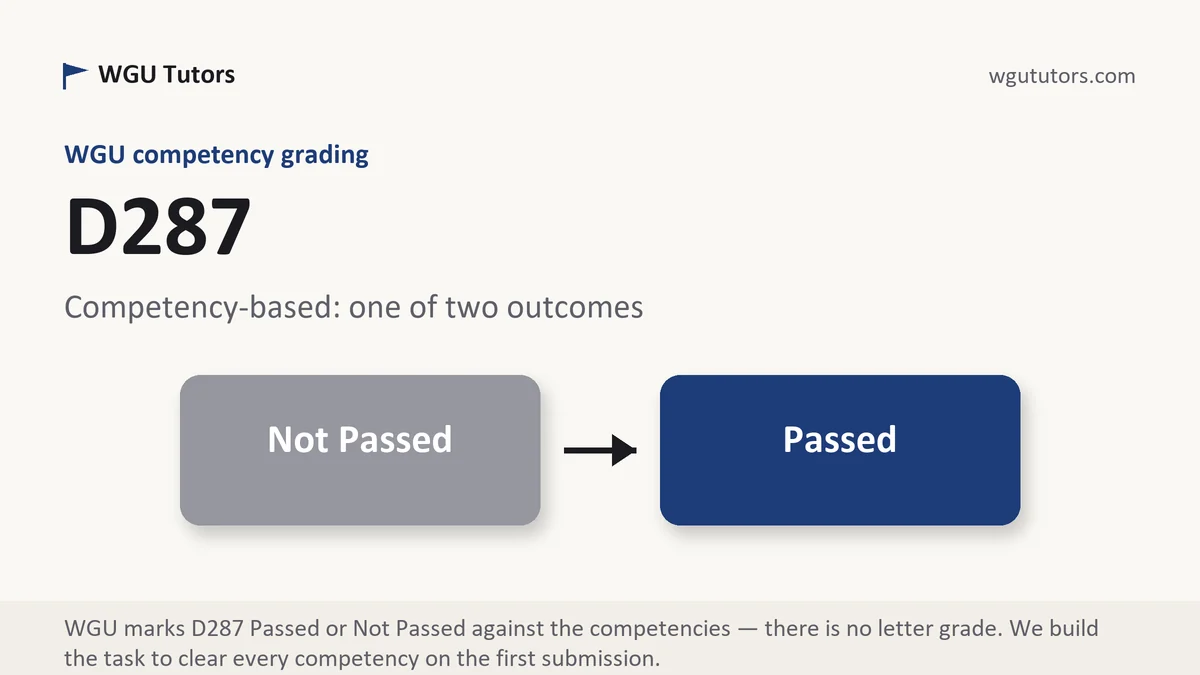
Work at WGU is Competent or Not Competent, there are no letter grades and no ordinary grade point average, and performance assessment work returns for revision without penalty when an aspect falls short. The expense is calendar time inside a six month flat rate term, so a first submission that runs cleanly for a stranger is worth more than one extra feature.
Passing submissions start from a clean checkout with documented steps. Their layers are actually separated, so business rules live in the service layer and nowhere else. Their exception strategy is described as a strategy rather than as a list of try blocks. And their justification sections say why this framework suited this application rather than repeating the framework's marketing description.
Returns follow a pattern. Business logic inside the controller. A broad catch swallowing exceptions and logging nothing useful. Configuration hardcoded so the project runs only on the author's machine. And an aspect about dependency injection answered with a definition rather than an account of how it is used in this application and what it made possible.
Six time sinks in D287
- Copying a starter project and building on top blindly. Every unexplained file becomes a question you cannot answer if an aspect asks about structure.
- Debugging by adding print statements inside framework code. Read the stack trace from the top for the first line in your own package, which is almost always where the answer is.
- Catching Exception everywhere. A broad catch hides the specific failure and turns a diagnosable bug into a mystery.
- Letting the controller do the work. Rules in the entry layer make the service layer decorative and make structural aspects unanswerable.
- Version drift. A tutorial written for an older framework release will produce code that does not compile against yours, and the error will look like your mistake.
- Leaving configuration in code. Hardcoded connection details are the most common reason a project that works for you fails for whoever evaluates it.
How we work on this course
Support for D287 is architecture and failure planning. Send the scored aspects and the requirements and you get a layer plan naming the class that satisfies each row, a failure mode table that becomes your exception strategy, a configuration checklist so the project runs elsewhere, and a model document in the register WGU evaluators expect. Code review names the structural defect and the principle it breaks. Where a section is assessed by an objective assessment, support is preparation only, and objective assessments are proctored: we never sit or assist during one and never ask for or touch WGU portal credentials.
Frameworks reward front loading more than most technology courses, because a layering mistake made in the first hour costs a rewrite in the last one. In a six month flat rate term that rewrite is the difference between three courses closed and two.
Three questions D287 students ask
Is D287 the same course as ITSW 3173?
Should I take D286 before D287?
How much of the framework do I actually need to learn?
Where D287 sits in WGU's programs
The July 2026 catalog places this code in 4 current WGU programs. Open a program page for the complete standard path and term positions. The live Degree Plan remains authoritative after transfer credit, substitutions, and mentor planning.
The assessments, one by one
The public catalog does not publish this course's PA/OA identity or task count. WGU Tutors publishes at most one PA manual per course and only from a WGU-controlled public rubric. Until that source exists, PA help begins from the student's real Course of Study and OA support remains preparation only.