This page is C949’s help desk: the honest read on the course and the exact support behind it. The course: Data Structures and Algorithms I, 4 CUs, in WGU's Computer science territory.
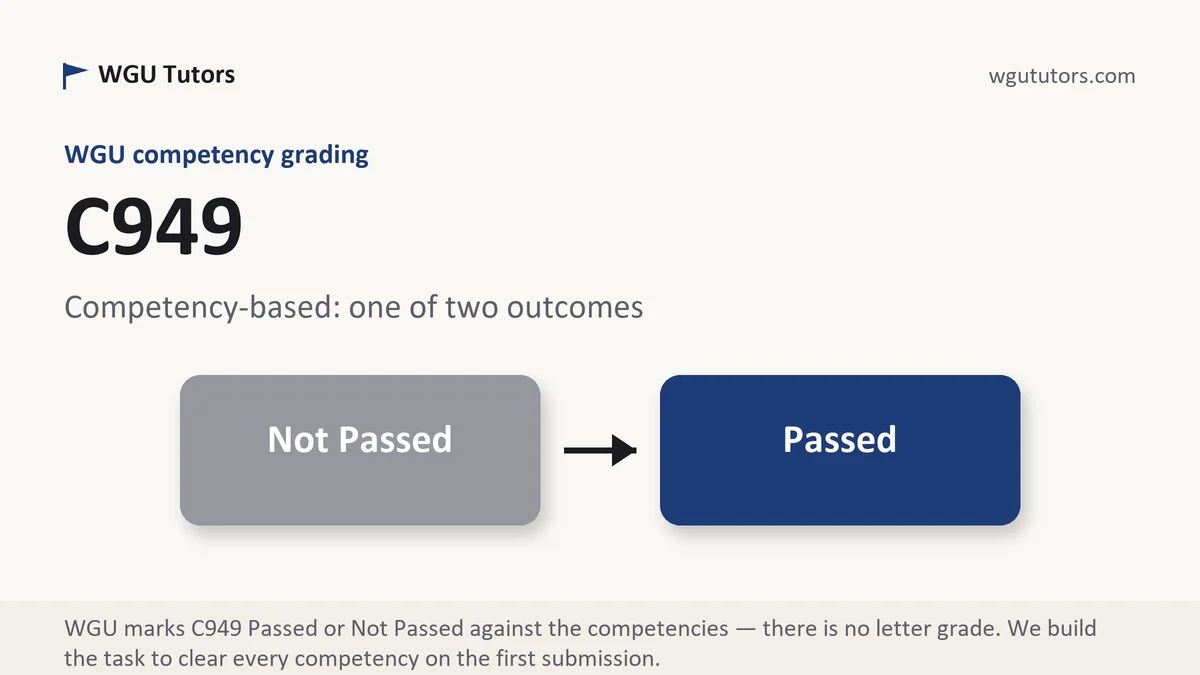
What C949 actually grades
The CS weeder: arrays through trees and hash tables, complexity analysis, and algorithmic reasoning, in a course that respects no shortcuts. Its reputation is earned, and so is the payoff, because interviews test exactly this material for the rest of your career.
How we help in this course
Support here is engineering tutoring at full depth: implementation write-ups documented like production code, complexity arguments made rigorous, and prep that drills the reasoning until whiteboard questions stop being scary. We treat C949 as career work wearing a course code.
Service terms are the site standard: performance-assessment work drafts in 24 to 48 hours, aspect-mapped to the current rubric with a walkthrough, revised free until the evaluation reads Competent and the course posts Passed; exam sections get preparation only, cut-score study plans, practice items, and a go or wait call, never a sit-in.
Task manuals for this course
Per-task manuals for C949, Task 1, Task 2, and exam-blueprint notes where they apply, publish as each identity verifies against the current course build; the chat desk knows live coverage same-day, and the service itself never waits on a manual.
In C949 right now?
Send the Degree Plan row and the rubric or preassessment report. First premium sample free, back in 24 to 48 hours.
Competent, defined for code and complexity
Where C949 grades written work, the aspects want implementation reasoning made auditable: the structure chosen and defended, the complexity argument carried in correct notation, the write-up documented so a colleague could maintain it. Where your section tests instead, support flips to preparation only, condensed notes and drills aimed at the cut score, with the proctored sit entirely yours. The Degree Plan row decides the mode, so send it first. Complexity claims get special attention in QA, because a write-up that asserts the wrong bound fails an aspect no amount of good prose recovers; every stated bound in a draft is checked against the implementation it describes.
The interview dividend, banked either way
This is the one course where the walkthrough deserves more attention than the deliverable, because the reasoning it teaches is what technical interviews will keep testing for the rest of a career. Clients are told to treat the returned draft as a worked example to study rather than a document to skim, and the ones who do report the whiteboard dread fading along with the course. Study the data-structure choices first; they carry the most transfer into interview settings.
Two questions from C949 students
Can you help if I am mid-attempt and stuck?
How current is the material you work from?
Turning scored aspects into a section plan
WGU keeps the scoring detail for each course inside your Course of Study rather than in the public catalog, so the first move in C949 is not opening an editor. It is opening the rubric and counting. Each aspect an evaluator scores is judged on its own against a three-point scale, and a score of 2 in each aspect is what passes the task. Nothing averages and nothing compensates: elegant code does not rescue a missing complexity argument, and a flawless complexity argument does not rescue code that fails on an empty input.
The planning consequence is unusual for a technical course. Engineers habitually organise a write-up the way they organised the work, which is rarely the way the aspects are scored. Give every scored aspect its own heading, worded close to the rubric's language, so that an evaluator scores by reading in order rather than by searching a document for the paragraph where you mentioned the thing.
The word budget, worked. Say your rubric shows seven scored aspects and the directions point at a write-up of roughly 2,100 words alongside your code artifact. Reserve 150 words to state the problem and 150 to close, leaving 1,800 for the scored body, which is about 260 words per aspect. Treat that as a floor and a ceiling together. An aspect answered in 70 words has asserted a choice without defending it, the most frequent return reason in technical coursework. An aspect that runs to 600 has swallowed a neighbour, and the starved neighbour is the one sent back.
Two aspects deserve deliberate overweight in a data structures course: the one asking why you chose the structure you chose, and the one asking for the complexity of what you built. Take 50 words from each descriptive aspect and give 100 to each of those. Code speaks for itself only to people who already agree with it, and an evaluator scoring a justification aspect needs the reasoning written down.
A structure that fits a data structures write-up
Where your task directions specify their own headings, those directions win. Where they leave it open, the arrangement below tracks how implementation aspects are usually scored and keeps the code and the prose describing the same program.
| Section | What belongs in it | How it gets scored |
|---|---|---|
| Problem and constraints | What the program must do, the input it accepts, and the limits it operates under | Rarely scored alone, but every later aspect is read against it |
| Structure selection | The data structure chosen, the alternatives considered, and why this one wins for this workload | Scored for defended reasoning; a named structure with no comparison reads as unmet |
| Algorithm design | The approach in words before it is in code, including how the operations fit together | Scored for clarity a maintainer could follow, not for cleverness |
| Implementation | The working code, commented at the level of intent rather than syntax | Scored on correctness and readability; uncommented dense code loses aspects |
| Complexity analysis | Time and space cost of each operation, in correct notation, derived rather than quoted | Scored strictly; a stated bound that does not match the code is a return on its own |
| Testing and evidence | The cases you ran, including empty, single, duplicate and boundary inputs, with results | Scored for coverage of edge cases, not for the count of tests |
| Limitations and sources | What the solution does not handle, plus any references, APA formatted | Scored where the rubric names citation; borrowed algorithms need attribution |
The pairing rule keeps the whole thing honest. Any bound claimed in prose must be provable from the code shown beside it, and any structure defended in the selection section must be the structure the implementation actually uses. A write-up that argues for a hash table while the code walks a list is the fastest possible return.
Evidence craft when the evidence is code
Technical coursework has an evidence problem that essay courses avoid. Your primary evidence is an artifact rather than a citation, and evaluators cannot award an aspect for behaviour they cannot see demonstrated.
- Derive the bound, do not announce it. Show the loop, count the work it does per element, and let the notation follow from the count. An asserted complexity is a claim; a derived one is evidence.
- Test the empty case and say so. Zero elements, one element, duplicates and the largest input you are willing to defend. Missing edge cases are the commonest gap in a testing aspect.
- Paste output, not promises. Where the directions allow evidence of execution, actual results carry an aspect that a description of results does not.
- Comment intent rather than syntax. A line saying that a counter increments tells a reader nothing; a line saying why the counter exists tells them everything.
- Attribute borrowed algorithms. Classic sorts and traversals are public knowledge, but a specific implementation you adapted has a source, and WGU runs submissions through a similarity check.
- Use APA for anything external, including textbooks, documentation and reference implementations you consulted.
The habit that separates strong technical writers is stating the limit of their own solution before an evaluator finds it. The structure degrades under heavy collision. The recursion depth is bounded by available stack. Naming that in one sentence, then explaining the tradeoff you accepted, reads as engineering judgment rather than as an oversight.
What separates Competent from a submission sent back
Aspects score independently, so returns in C949 are local. Work rarely comes back because the program was wrong. It comes back because an aspect asked for both an implementation and a justification, and the submission supplied only the implementation.
- Every scored aspect has a visible home, and its heading borrows the rubric's noun rather than a synonym you preferred.
- Every claim about performance is traceable to code shown in the same document.
- Every design decision names the alternative it beat. A choice with no rejected option is a preference, not a justification.
- The code compiles and runs as submitted, with any dependency or version noted.
- Nothing borrowed is unattributed, and nothing attributed is left unexplained.
Performance assessment work at WGU can be revised and resubmitted with no grade penalty, so a return is a delay rather than a disaster. The cost is calendar. A term runs six months at a flat rate, which makes courses closed per term the number that matters, and a return that burns a week of evaluator queue plus rework is often one course fewer this term.
Where your section is measured by a proctored objective assessment instead, the boundary does not move. Proctored exams are yours to sit. We build the study plan, drill the structures and the notation, run practice items and give an honest go or wait read on readiness. We do not sit assessments, and we never ask for portal credentials.
Six mistakes that cost time in C949
- Writing the code first and the reasoning last. The justification aspect is the one most often returned, and it is far easier to write before the implementation hardens around a choice you can no longer explain.
- Quoting a textbook bound for your own code. The average case for a structure in general is not the bound for your implementation of it. Derive from what you wrote.
- Skipping the empty and single-element cases. They are where most submitted implementations actually break, and they are the first thing an evaluator tries.
- Optimising before it is correct. A clever solution that fails one case scores worse than a plain one that passes every case, and the plain one can be discussed honestly.
- Writing to the prompt sentence instead of the rubric aspect. The prompt is prose and often folds two scored aspects into a single line. The rubric is the specification.
- Treating the write-up as paperwork. In a competency model the written reasoning is the assessed artifact as much as the code is, and thin prose returns a strong program.
Three more questions students ask about C949
How many competency units does C949 carry?
Will I see a letter grade or a GPA for this course?
Can you take my proctored assessment for this course?
Where C949 sits in WGU's programs
The July 2026 catalog places this code in 6 current WGU programs. Open a program page for the complete standard path and term positions. The live Degree Plan remains authoritative after transfer credit, substitutions, and mentor planning.
The assessments, one by one
The public catalog does not publish this course's PA/OA identity or task count. WGU Tutors publishes at most one PA manual per course and only from a WGU-controlled public rubric. Until that source exists, PA help begins from the student's real Course of Study and OA support remains preparation only.