C655 Zoology, catalog number BIO 5101, is the two-CU graduate introduction to the animal kingdom in the WGU School of Education, covering the major animal phyla with emphasis on their characteristics, the variation in their anatomy, their life cycles and their adaptations. It is the course with the largest raw content volume of any two-CU science course on a teaching plan, and the students who struggle are the ones who try to memorise it rather than organise it.
Organisation beats memorisation
There are more animal phyla than anyone can hold as a list, each with its own anatomy, its own reproductive strategy and its own set of adaptations. Treated as a list, the course is impossible. Treated as a small number of body-plan problems solved repeatedly in different ways, it becomes tractable and, for a future teacher, far more useful.
Those problems are the organising spine. How does an animal maintain body symmetry and what does that permit. How many tissue layers does it develop and what body cavity results. How does it exchange gas, move material internally, excrete waste, sense the world and reproduce. Every phylum is a set of answers to that same short list of questions, and once a student sees it that way, an unfamiliar organism becomes something to reason about rather than something to look up.
Anatomy variation, named directly in the catalog scope, is best learned the same way. A circulatory system is a solution to internal transport, and the open system of an insect, the closed single-circuit system of a fish and the double circuit of a mammal are three answers to one problem, each fitting a particular size, metabolic rate and habitat. Learned as three separate systems they are three memory tasks; learned as three answers they are one idea with three cases, and a candidate can then reason about a fourth animal never studied.
Graduate expectations add the evolutionary layer. Similar structures may share ancestry or may have arisen independently under similar pressures, and telling those apart is the difference between reciting anatomy and understanding it. A submission that describes a structure without saying whether it is homologous or convergent is answering a lower-level question than the one asked, and reviewers in a graduate science course notice.
Turning scored aspects into a work plan
Open your Course of Study before planning. The scoring detail lives there rather than in the public catalog, and a School of Education science course may be assessed by a submitted performance assessment, by a proctored objective assessment, or by both. Content of this volume needs a different schedule depending on which one applies.
Under a performance assessment, each scored aspect is judged on its own against a three-point scale and a 2 in every aspect passes the task, with no averaging. Head each section with the rubric's own noun so the evaluator scores by reading in order rather than searching a long comparative document.
The word budget, worked. Comparative tasks sprawl unless budgeted. With five scored aspects and directions asking for about 1,800 words, reserve 140 for framing and 120 for a close, leaving 1,540, roughly 308 per aspect. In zoology, resist spending those words on description. Allocate about 100 to the structure or process, 120 to the functional explanation of why it works in that animal's environment, and 88 to the comparison that makes the point. Descriptive writing is what inflates zoology submissions and it is the least scored material in them.
Where a proctored component applies, build a comparison table across phyla for each body-plan question rather than studying phylum by phylum. The table is what makes the material recallable under time pressure.
A structure that fits a comparative zoology response
Task directions govern where they set a shape. Where they do not, this arrangement stops a comparative response from becoming a catalogue.
| Section | What belongs in it | How it gets scored |
|---|---|---|
| Functional question | The problem being solved: gas exchange, support, feeding, reproduction or sensing | Frames the comparison; without it the response becomes a list |
| Solutions across taxa | How different phyla solve it, with the structures named accurately | Scored for accuracy and for range rather than for volume of detail |
| Environmental fit | Why each solution suits the habitat and lifestyle of that group | The functional reasoning aspect and the one that separates graduate work |
| Evolutionary relationship | Whether the similarity is inherited or convergent, with the evidence | Scored where evolutionary reasoning is named |
| Life cycle note | How development or reproduction differs and what that implies | Scored where life cycles are named; often the thinnest section in drafts |
| Teaching connection | How the comparison would be presented to students and what they misunderstand | Scored where pedagogical aspects appear in a teaching programme rubric |
Where dissection, specimens or live animals appear in any part of the course, handle the ethical and safety dimension explicitly. A graduate science submission that describes classroom animal work without addressing welfare, alternatives and district policy reads as incomplete to a reviewer preparing teachers.
Evidence craft in zoological writing
Zoology submissions are judged partly on taxonomic precision, which is unforgiving in a way that general biology writing is not.
- Write scientific names correctly, italicised with the genus capitalised, and give the taxonomic level you mean rather than using vague group words.
- Use current classification. Molecular phylogenetics has rearranged animal relationships substantially and older textbook trees are in places simply wrong.
- Support functional claims with evidence rather than plausibility. A structure that looks suited to a purpose may serve another, and adaptive storytelling is a known failure mode in this subject.
- Cite comparative sources when claiming a pattern holds across a group, since exceptions in zoology are abundant.
- Handle animal welfare references with named policy or guidance rather than general assurances.
- Keep quotation minimal; phylum characteristic lists are heavily reproduced text and WGU runs submissions through a similarity check.
The strongest zoology writing resists teleology. Animals do not develop features in order to solve problems; variation and selection produce features that happen to work. Phrasing that respects this is a marker of graduate-level understanding and reviewers in a teaching programme watch for it, since teleological language transmits straight to students.
What separates Competent from a return
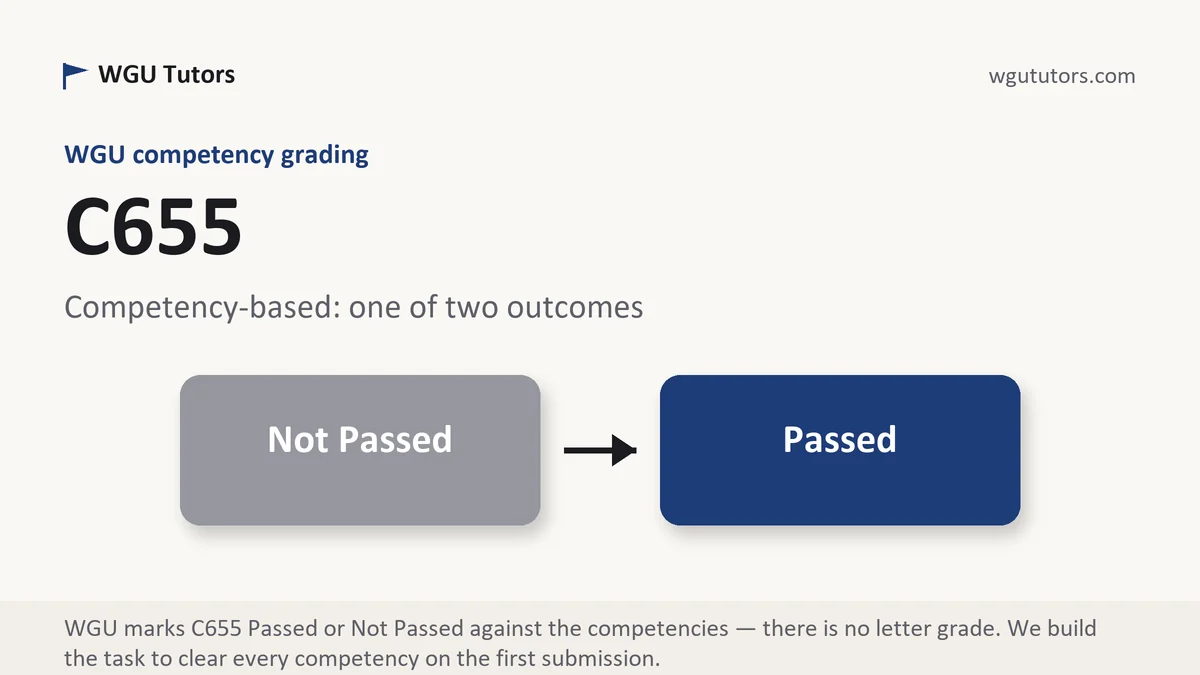
Work is recorded as Competent or Not Competent, with no letter grades and no ordinary grade point average. Each aspect is scored independently, so zoology submissions usually return for a specific weakness rather than a general one.
- Every scored aspect has its own heading using the rubric's wording.
- Every structure described is connected to the function it serves in that animal's environment.
- Every similarity claim states whether it reflects shared ancestry or convergence.
- Every taxonomic reference is precise and current.
- No sentence implies that animals acquire traits because they need them.
Performance assessment work can be revised and resubmitted with no grade penalty, so a return is a delay rather than a setback. In a six-month flat-rate term the delay is the real cost, since the number of courses you close inside the term decides your effective cost per course.
Where a proctored objective assessment applies, the line does not move. Proctored assessments are yours to sit. We prepare with comparative frameworks, drilled characteristics and an honest readiness call, and we never ask for portal credentials.
Five mistakes students make in C655
- Studying phylum by phylum. Organising by functional problem across taxa is faster to learn, easier to recall and closer to what graduate aspects ask for.
- Describing instead of explaining. Anatomical description is the least scored material in a comparative submission.
- Using outdated classification. Animal phylogeny has changed and older trees are not merely simplified, they are in places incorrect.
- Writing teleologically. Language implying purpose in evolution is the most common register error in zoology writing, and it passes straight to students who hear it.
- Ignoring life cycles. Development and reproductive strategy explain much of the diversity in the animal kingdom and are routinely underwritten in drafts.
- Leaving animal welfare unaddressed. Any classroom work with specimens or live animals carries policy, alternatives and welfare considerations, and a submission that skips them reads as a candidate who has not thought about the classroom version of the work.
How support works on this course
Send your Course of Study for C655 with any rubric and task directions. What comes back is a comparative framework organised by functional problem rather than by phylum, a classification check against current phylogeny, a language pass that removes teleology from your explanations, and an aspect-mapped draft where the functional reasoning carries the weight instead of description.
Where a proctored component applies, the same framework becomes a study grid: one row per functional problem, one column per major group, filled in from your own reading. Building the grid is the studying, and reviewing it takes minutes rather than hours.
Zoology rewards structure more than effort. Two competency units of content organised well takes a fraction of the time the same content takes memorised, and the framework transfers directly into how you would teach it.
Questions students ask about C655
Is C655 the same course as BIO 5101?
How do I handle so much content in two competency units?
Will you sit a proctored assessment for me?
Drowning in phyla with two CUs to show for it?
Send your Course of Study and any rubric. You get a comparative framework by functional problem, a current classification check, and aspect-mapped drafting.
Where C655 sits in WGU's programs
The July 2026 catalog places this code in 1 current WGU program. Open a program page for the complete standard path and term positions. The live Degree Plan remains authoritative after transfer credit, substitutions, and mentor planning.
The assessments, one by one
The public catalog does not publish this course's PA/OA identity or task count. WGU Tutors publishes at most one PA manual per course and only from a WGU-controlled public rubric. Until that source exists, PA help begins from the student's real Course of Study and OA support remains preparation only.