AIAPP AI Skills Fundamentals Capstone: How to Pass It at WGU
AI Skills Fundamentals Capstone now has its complete place in WGU's July 2026 program network: exact code, CCN identity where published, CUs, standard-path terms, and every current program connection.
AI Skills Fundamentals Capstone develops the applied knowledge represented by this catalog-listed course in its program sequence.
What AIAPP work asks you to make visible
At the reasoning level, this course rewards integration under an authentic constraint. The student must perform the real field, simulation, capstone, or professional work; the written layer then has to connect decisions, evidence, observations, results, limitations, and reflection without inventing any experience. The title tells you the subject, while the live Course of Study tells you the instrument and the rubric. Keep those two sources separate: a catalog entry can establish course identity but cannot prove that every student sees the same paper, project, simulation, or exam.
Start by turning the current directions into an evidence map. Give every scored criterion its own row, copy the exact action verb, name the fact or source that can support it, record the artifact where it will appear, and mark the final verification step. This prevents fluent background from consuming space while one small but independently scored requirement remains invisible.
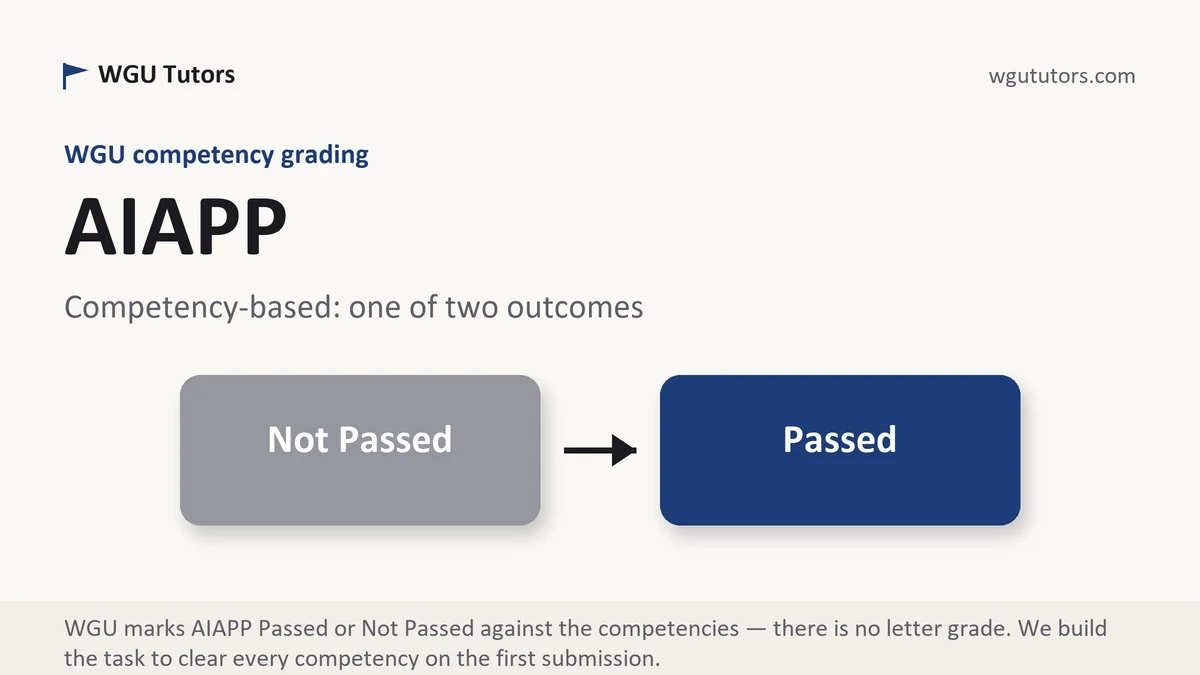
WGU's competency model makes completeness more important than flourish. One impressive section does not compensate for one unmet rubric aspect, and an objective assessment does not reward pages of passive rereading. The efficient response is instrument-specific: aspect coverage and evaluator-readable structure for a PA; competency diagnosis, retrieval practice, and a readiness decision for an OA.
Turn the live Course of Study into a working plan
| Rubric job | What competent work makes visible | Return risk |
|---|---|---|
| Purpose | The approved outcome and boundary | A broad ambition |
| Context | Real setting facts, permissions, and constraints | Invented detail |
| Action | What the student actually did and why | Passive chronology |
| Evidence | Artifacts, observations, results, and limitations | Unsupported success |
| Reflection | Learning tied to a changed future decision | A feelings recap |
Use that table as a diagnostic vocabulary, not as a claim about the current assessment. Replace its left column with the registered rubric or competency language. Then write a one-sentence success test for each row: what would an evaluator, reviewer, or exam result have to show for this item to count as competent?
For a written performance assessment, budget effort by reasoning difficulty rather than by equal section length. Descriptive rows may need a compact paragraph or table; analysis, comparison, implementation, and evaluation rows need room to expose their logic. For an objective assessment, convert the same map into short retrieval sets and worked scenarios, then schedule the exam only after the preassessment evidence is stable.
A structure for the dominant course artifact
A useful capstone plan, field-experience narrative, or applied reflection moves from the required decision to the evidence and then to action. Where the Course of Study supplies headings or a template, its language wins. Where it does not, use a sequence that lets the reader answer five questions without hunting: what is being decided, what is known, how was it analyzed, what follows, and what could make the conclusion wrong?
Open with scope rather than history. Name the setting, audience, period, constraint, and decision. Put definitions next to the first point that needs them. Place calculations, code excerpts, tables, or figures beside the sentence that interprets them. Close with an action, owner, measure, and limitation instead of repeating the introduction in different words.
Run a cross-artifact check whenever the task includes more than one file. Numbers in a workbook must match the report; a diagram must match the configuration it illustrates; code must implement the design the write-up claims; appendix labels must be cited in the body. Small contradictions across files are especially costly because each file may look correct on its own.
Evidence, data, and source discipline
Build from contemporaneous notes and approved artifacts. Distinguish what the student observed from what a source establishes, remove protected or proprietary identifiers, and make every claimed hour, interaction, result, and decision traceable to real work.
Maintain a claim ledger with four fields: claim, source or case fact, limitation, and destination section. The ledger stops a source from being stretched beyond the population, design, jurisdiction, or date it actually covers. It also exposes unsupported adjectives—effective, significant, best, safer, more efficient—that often hide a missing comparison or measure.
Use original or authoritative sources when the claim concerns standards, frameworks, regulations, vendor behavior, or published research. Use the task's scenario facts for the local context, and never convert a workplace observation into a published fact by attaching an unrelated citation.
Finish with a mechanical audit: every in-text citation has a reference; every number has a unit, period, and source; every abbreviation is defined; every table reconciles to prose; every heading answers a live requirement; and every conclusion is no broader than the evidence. This pass catches more return-causing defects than another stylistic rewrite.
What Competent looks like—and what sends work back
Competent work is complete, traceable, and bounded. It answers the requested action verb, uses the appropriate concept or method, shows the reasoning between evidence and conclusion, and respects the format or submission channel. Work returns when it is polished but indirect, when an output has no visible method, when a recommendation has no owner or measure, or when a citation is present but does not support the claim beside it.
- Mirror the current rubric or competency wording without copying explanatory boilerplate into the response.
- Give every calculation, factual claim, and recommendation enough provenance to be checked.
- Separate description, analysis, judgment, and action so the evaluator can see each job.
- State assumptions and limitations before they are discovered by the reviewer.
- Use the official template, file type, naming rule, and submission channel shown in the Course of Study.
- For an OA, use preassessment evidence to decide when to sit; preparation never becomes live-exam assistance.
WGU's flat six-month term changes the cost of delay. A returned task or repeatedly postponed exam does not lower a GPA—WGU does not calculate one—but it can push the degree into another full term. The responsible acceleration method is not shortcutting the assessment. It is removing ambiguity early, practicing the correct instrument, and submitting or scheduling only when the evidence says the work is ready.
Where AIAPP sits in the program network
The July 2026 catalog places this code in 1 current WGU program. Standard-path term numbers are sequencing guidance, not weekly calendars, and an individual Degree Plan can change through transfer credit, prior learning, approved substitutions, program updates, or mentor planning.
Open the program page to see every class in order, then return here for the course method. That creates the Capella-style chain the site is meant to support: program → class → verified assessment manual. The last link appears only when WGU has publicly established the real assessment identity and requirements.
The work that remains the student's
This course carries an applied, field, or capstone identity. The student performs every real placement, classroom, project, simulation, interaction, approval, hour, and submission step. Tutoring may help plan or review a de-identified written artifact, but it cannot create experience, data, signatures, or outcomes.
Protected student records, minors' information, employee records, customer data, proprietary financials, and identifying case details must be removed before material is shared. The student remains responsible for professional judgment, real interaction, classroom or field performance, truthful documentation, originality, and the final decision to submit.
The assessments, one by one
The public catalog does not say whether this course uses a PA, an OA, or both, and it publishes no stable Task 1 or Task 2 list. The live Degree Plan and Course of Study are authoritative. A course code, CU value, standard-path term, or generic WGU assessment description is never treated as proof of a specific task.
WGU Tutors publishes at most one public PA manual per course, only after a current WGU-controlled source verifies the assessment. Until then the course page remains the complete public method layer: PA help begins from the student's real rubric, while OA support is preparation and coaching only.
Questions about AIAPP
What is AIAPP at WGU?
Does AIAPP use a PA or an OA?
Can tutoring help with a WGU objective assessment?
Where are the AIAPP task manuals?
Working on AIAPP now?
Send the code, current Course of Study directions, and rubric or preassessment report. We identify the instrument and build the right support plan without touching your portal.